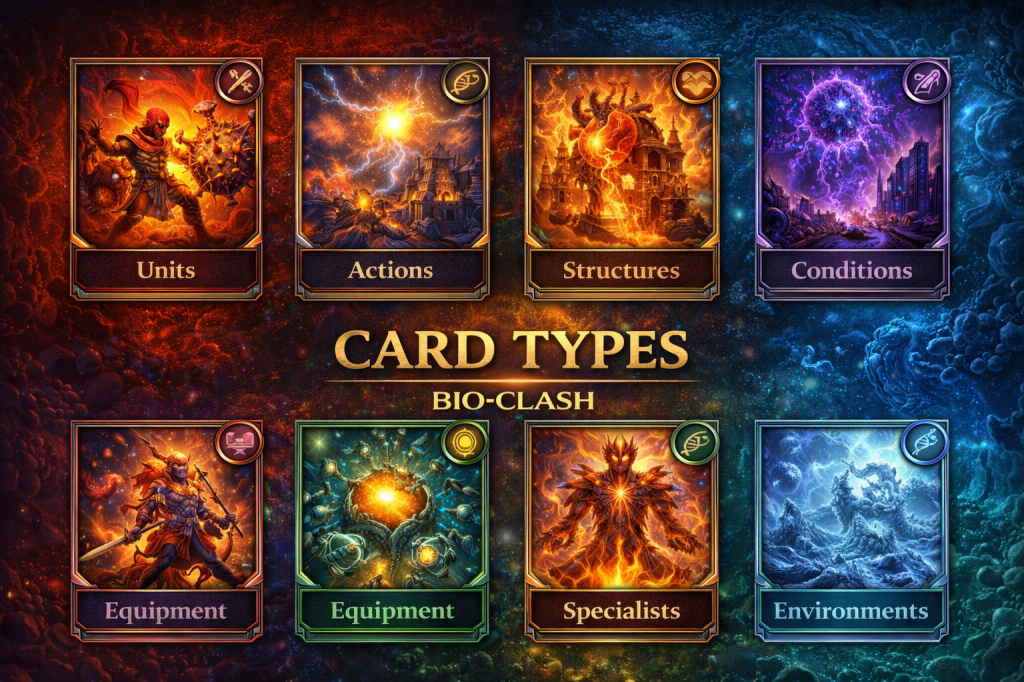
BIO-CLASH turns real biology into a strategic card game.
To keep the game clear and true to science, every card belongs to a specific type — just like biology itself has agents, events, systems, and states.
Each type has a strict role:
Units
Living agents. The main fighters of BIO-CLASH.
Units represent individual biological entities — cells, viruses, bacteria, engineered organisms, hybrids — but the art focuses on what they do, not what they literally look like.
What Units do:
- Attack and defend
- Take damage
- Can be destroyed
- Build synergy when played in numbers
Units always show:
- Attack (crossed surgical scalpels icon) — bottom left
- Vitality (anatomical heart icon) — bottom right
- ATP Pathway cost — top right
Actions
Instant biological events. One-time effects.
Actions represent fast biological moments: chemical releases, signaling bursts, sudden reactions, and quick interventions.
Think of Actions as:
- A burst of signaling
- A sudden discharge
- A rapid reaction
- A one-time biological event
If an effect is meant to last, it becomes a Condition, Structure, or Environment instead.
Structures
Persistent biological systems and locations.
Structures represent organs, barriers, tissues, and functional networks — the systems that change how the battlefield works over time.
Structures:
- Stay in play
- Modify rules, interactions, or production
- Represent systems, not individual organisms
Examples include organs, tissue zones, defensive barriers, and network hubs.
Conditions
Ongoing biological states attached to Units.
Conditions represent what a Unit is currently experiencing — infection, inflammation, mutation, hypoxia, apoptosis, and more.
Conditions:
- Attach to a Unit
- Persist until removed or resolved
- Represent states (not objects)
- Can be harmful or beneficial
Equipment
Biological or technological tools that enhance function.
Equipment in BIO-CLASH can work in two ways:
1) Attached Equipment (Units only)
Equipment can attach to Units to represent integrated tools or modifications — biological or technological.
2) Field Equipment (Persistent System)
Some Equipment exists on the battlefield as a persistent system until removed (like an “enchantment” effect).
✅ Equipment can attach to Units
❌ Nothing attaches to Specialists
That rule is strict and always true.
Specialists
Mythic embodiments of biological control and intelligence.
Specialists are not normal fighters.
They represent system-level regulation — the “minds” of biology: coordination, memory, oversight, prediction, and control.
Specialists:
- Use influence-style abilities to reshape the battlefield
- Represent control systems, not physical agents
- Are rare, story-defining entities in the BIO-CLASH universe
Important canon rule:
❌ Nothing attaches to Specialists (no Equipment, no Conditions)
Environments
Global battlefield states. No stats. Affects everything.
Environments represent the conditions biology is forced to fight inside — internal or external.
Examples include:
- Fever
- Hypoxia
- Radiation zones
- Microgravity
- Septic shock states
Environment rules:
- Affect the whole battlefield
- Have no Attack and no Vitality
- Stay active until removed or replaced (depending on rules)
Why This System Matters
BIO-CLASH works because each type mirrors real biology:
- Units = agents
- Actions = events
- Structures = systems
- Conditions = states
- Equipment = tools
- Environments = global context
- Specialists = regulation and control
It keeps gameplay strategic and readable — while letting the art and lore be as mythic and cinematic as possible.
 BIO-CLASH